Interest Islands
Interest Islands are RSSMonster’s personal semantic layer. They represent areas that a user repeatedly engages with—or explicitly avoids—rather than the news itself.
Examples might include artificial intelligence, photography, self-hosting, electric vehicles, or a particular game franchise. Every user’s Islands are private to that account and are learned only from that user’s articles and behavior.
An Interest Island answers what does this user consistently care about? It is not an Event, a a feed category, or simply a folder of similar articles.
Where Islands Fit
Articles and reading behavior
        |
        v
Behavioral article profiles
        |
        v
Candidate Interest Islands
        |
        v
Persist or update Islands
        |
        v
Score unread articles
Events describe individual occurrences. Interest Islands learn from canonical article behavior and match candidate article vectors directly.
Behavioral Evidence
Island calibration starts with canonical, vectorized articles that carry an explicit behavioral signal. The current signal weights are:
| Signal | Contribution |
|---|---|
| Positive feedback | +8 |
| Bookmark or favorite | +4 |
| Outbound click | +1, up to two clicks per article (+2 maximum) |
| Deep read | +1 when attention bucket is at least three |
| Negative feedback | -8 |
Each signal ages from its own interaction timestamp with a true half-life: weight(age) = 2^(-max(0, ageDays) / halfLifeDays). Clicks halve after 30 days, deep reads after 90, favorites after 365, more-like-this after 730, and not-interested after 365. There is no permanent minimum multiplier. These are initial product defaults: incidental clicks fade quickly, reading lasts longer, and deliberate preferences persist for one or two years before halving. The raw weights above and capped click count are unchanged.
An article can contain several signals. For example, bookmarking and deeply reading an article provides stronger evidence than opening it once. Negative feedback produces signed evidence, allowing RSSMonster to learn that a semantic area should reduce rather than increase personalized relevance.
Bookmarks are especially clear evidence because they represent an explicit decision to retain an article. See Bookmarks.
Forming Candidate Islands
RSSMonster groups behavioral article profiles by cosine similarity. The strongest positive or negative evidence is processed first. An article joins the closest existing candidate when similarity is at least 0.64 by default. Otherwise, it starts another candidate until the calibration community limit—ten by default—is reached. If no candidate qualifies after that, the profile remains unassigned. Capacity never forces unrelated evidence into a nearby Island. The community limit is not a hard count of all stored Islands.
Each candidate receives:
- an aggregate vector weighted by the magnitude of its article evidence;
- a signed weight based on average behavior plus a small breadth bonus;
- counts of the signals supporting it; and
- the source articles that explain why it was formed.
The weight is bounded from -1.0 to 1.0. Positive weights can boost related content, while negative weights can penalize it. A weight is a preference signal, not a quality or truthfulness rating.
The current implementation can create a candidate from one sufficiently strong vectorized article. Further related behavior makes the Island broader and more stable over subsequent calibrations.
Preserving Existing Islands
Candidate profiles are compared with the user’s stored Islands. A similarity of at least 0.78 reuses an existing Island. Its vector is blended with the new profile using a default new-evidence weight of 0.35; it is not replaced abruptly. Stored behavioral counters are replaced by the current evidence snapshot, so recalibrating unchanged favorites/clicks does not count them again. Audit entries may record each run but are not new behavioral evidence.
If no Island qualifies, RSSMonster creates a new one. This preference for updating existing Islands gives them continuity as reading habits evolve.
An Island, including one that still matches an old behavioral profile, can be archived when both conditions hold:
- its lifecycle confidence from current decayed support is below
0.12; and - its latest meaningful supporting interaction is at least 45 days old, or no qualifying interaction time remains.
Archived Islands remain available for inspection but are excluded from direct Island scoring; explicit Article fallback retains its separate existing rules. They remain candidates for profile matching at the existing threshold. A strongly supported matching profile with an interaction newer than archivedAt reactivates the same Island ID; recalibrating the same old evidence does not. For legacy archives without archivedAt, support must be strong and recent (not stale). No historical Island is automatically deleted.
Behavioral lifecycle
updatedAt records technical persistence only. Calibration, vector blending, renaming and audit writes never supply behavioral activity. lastBehaviorAt is derived during lifecycle evaluation rather than stored as another timestamp. It is the latest valid, non-future interaction clock on currently meaningful support, with the existing publication fallback for null legacy clocks. Each contributing signal and its Article’s absolute net evidence must reach the existing .05 signal threshold; an exhausted incidental click cannot make an otherwise old preference look recent.
Lifecycle confidence is separate from scoring confidence:
signalRetention = max(decayedSignal / rawSignal)
agreement = abs(decayedPositive - decayedNegative)
            / (decayedPositive + decayedNegative)
remainingSupport = max(signalRetention * agreement)
lifecycleConfidence = existingSupportConfidence * remainingSupport
signalRetention takes the strongest independently normalized signal whose decayed contribution reaches the existing .05 signal threshold. This is its existing recency multiplier; raw weights and decay are unchanged. An aging click cannot dilute a surviving favorite, including before that click becomes exhausted. agreement preserves signed cancellation using the full decayed positive and negative evidence. It is 1 for same-direction evidence and 0 for exact cancellation; a zero total gives zero agreement. No meaningful signals gives zero retention.
The maximum is over currently qualifying supporting Articles. Empty support gives zero lifecycle confidence; exhausted Articles do not contribute to support confidence. Using the strongest remaining fraction prevents a large volume of old weak history from diluting a surviving deliberate preference. Conflicting evidence can lower an Article’s remaining signed support. The existing recommendation confidence formula is not changed or multiplied again during scoring.
- Active: not archived; recent activity or sufficient decayed support keeps the Island eligible for scoring, subject to active capacity. An old but strongly supported preference can remain active.
- Stale: no meaningful interaction within
ISLAND_ARCHIVE_STALE_DAYS(default 45). Staleness alone does not archive a strong preference. - Archived: stale and below
ISLAND_ARCHIVE_CONFIDENCE_THRESHOLD(default.12) at calibration, or displaced by the active-capacity policy. Matched and unmatched Islands are evaluated; the original archive timestamp survives repeated calibration. - Reactivated: an archived Island wins normal profile matching and has lifecycle confidence at least
.12plus a newer meaningful interaction, and wins an active-capacity slot.
Matched profiles use their actual supporting Articles. Unmatched active Islands use the existing nearest-support rule among active Islands. Both reuse the full owned, canonical, unfiltered Article snapshot already loaded for formation, including evidence that has decayed below profile eligibility. This avoids a second history query and avoids mistaking the scoring helper’s 500-row evidence limit for absence of lifecycle support. Archived unmatched Islands need no support scan. Duplicate-name archival remains a separate existing rule.
Lifecycle updates occur in the existing calibration transaction and replay checkpoint. A scoring retry reuses the committed lifecycle decision; it neither rewrites interaction clocks nor resets archival. A new behavior request causes the existing refresh flow to recalibrate.
The existing AI worker also checks for aging personalization hourly and requests a full refresh when its last successful calibration and unread rescore is at least 24 hours old. This lets preferences fade even when you take no new actions. Scheduled refreshes preserve matched Island centroids and behavioral timestamps; new behavior still permits normal vector adaptation. Refreshes can be delayed by crawls, queued work, or an unavailable worker.
Configure PERSONALIZATION_REFRESH_INTERVAL_MS (default 86400000), PERSONALIZATION_REFRESH_CHECK_INTERVAL_MS (3600000), and PERSONALIZATION_REFRESH_BATCH_SIZE (25) in the worker environment. Each check queues a bounded batch of due users and spreads it across the check interval. The per-user personalizationRefreshedAt clock survives job-history cleanup and advances only after a full refresh succeeds. Failed jobs retain normal retry and operator-recovery behavior.
Island Names
RSSMonster first tries to label an Island using the nearest active semantic taxonomy name. When no taxonomy label is available, it uses the strongest source article title.
Names are disambiguated with source-article phrases or unique suffixes. This is presentational: even identical vectors with the same normalized name remain separate active evidence, preserving positive and negative preferences. Audit count and absolute weight select who retains the base name, not semantic availability. Name cleanup does not archive, merge, or reactivate Islands. Normal lifecycle and active-capacity policies still apply.
Population Audit
Each Island keeps a bounded audit history explaining how it was populated. An audit entry can include:
- contributing article IDs;
- counts of related, bookmarked, clicked, and negatively rated articles; and
- compact snapshots of source-article evidence.
By default, RSSMonster retains the latest 30 calibration entries and up to 300 article IDs per entry. The audit supports the Why this island exists view; it is never fed back into clustering as new semantic evidence.
Article Interest Scores
After calibration, RSSMonster recalculates interest scores for canonical, unfiltered, unread articles.
Personalization separates signed preference strength, confidence in the Island’s behavioral support/cohesion, and confidence in the Article’s relationship to it. A coherent singleton remains useful but has lower confidence (0.35) than a coherent interest supported across multiple articles, sources and interaction days. These confidence measurements are derived from current bounded evidence, not stored audit history; diagnostic classifications do not automatically delete Islands.
Direct Article → Island matching requires similarity strictly above the existing scoring threshold (0.62 by default) and normalizes confidence within the trusted range. Weak relationships cannot forward full Island preference.
Explicit likes/favorites/dislikes without a qualifying same-sign Island can also transfer through a bounded behavioral fallback. It uses recent source articles, semantic confidence and content-intent compatibility. A promotional dislike transfers much less to a review than to another promotion, even for the same product. Missing intent conservatively attenuates; unread/no-click/missing engagement is not negative feedback. Recency uses the corresponding Article interaction timestamp. Publication time is only a fallback for legacy state with a null interaction timestamp.
The strongest adjusted path wins per Island. Across Islands and explicit evidence, the strongest positive and strongest negative contributions are added and bounded; correlated paths do not stack. The internal Island scoring reference owns the exact confidence, fallback and aggregation formulas.
No trustworthy path means interestScore = 0. Every eligible article still receives a runtime Recommended score from its other signals; personalization coverage may be much lower than Recommended coverage. See Scoring.
Interest scores influence sort:recommended, where positive scores boost and negative scores penalize an article. They also support Daily Briefing eligibility and semantic filtering. The score is derived output: it does not become new behavioral evidence and does not itself change an Island.
Inspecting Your Islands
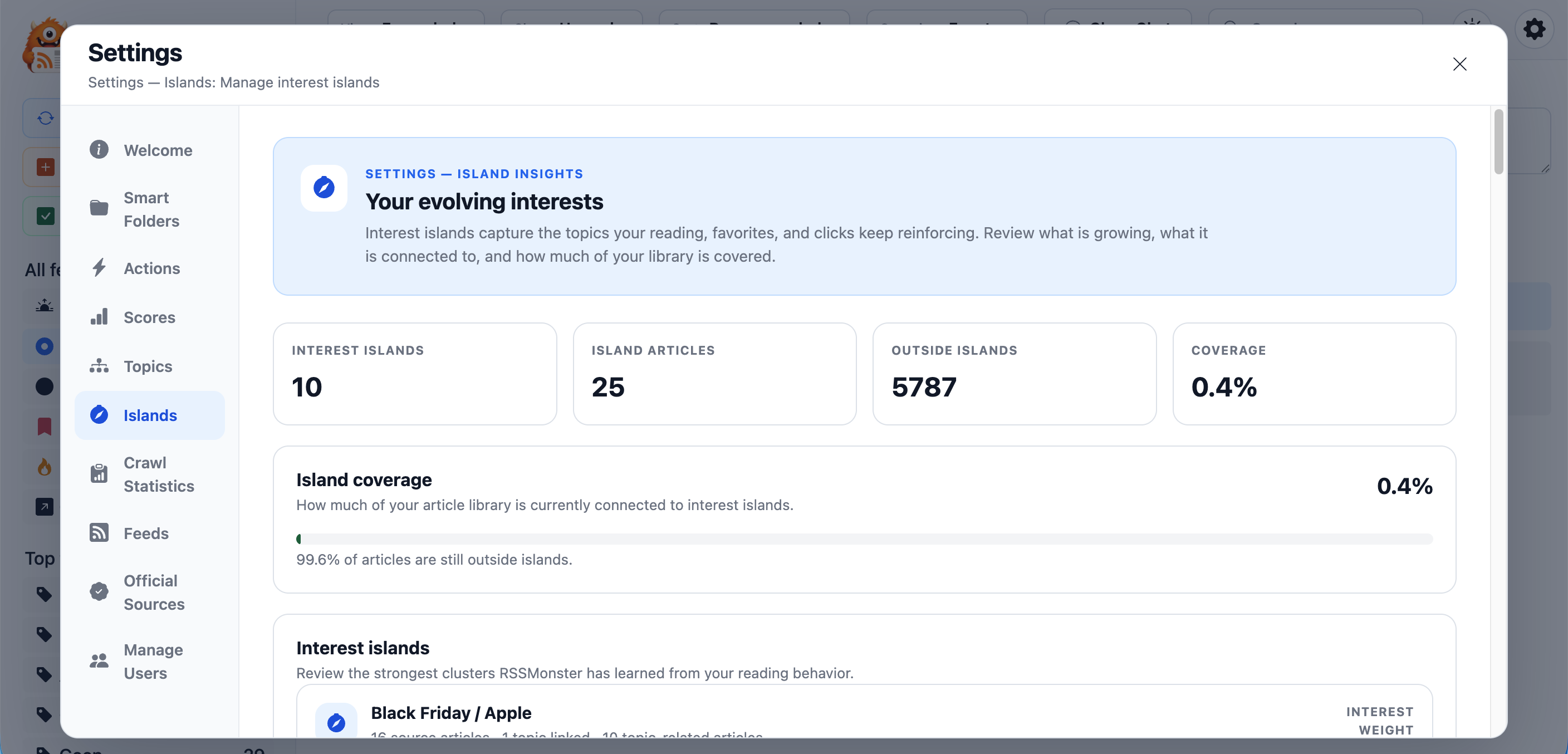
Open Settings → Islands to review and configure the interests RSSMonster has learned. The Island Insights introduction stays at the top of the page, followed by summary cards for positive, negative, active, and archived interests. The Active filter is selected when you open the page. Use the other filters, search, and sort control to find an Island. Each row shows its preference polarity, evidence strength, supporting behavior, last activity, and lifecycle. Evidence strength is preference magnitude, not confidence in a recommendation.
Select Inspect to see an Island’s evidence breakdown and example articles. If an article’s Why recommended explanation says it matches one of your interests, select the interest name to open Settings → Islands with that Island selected and inspected.
Muting an Island
Select Mute beside an Island to stop using it for future Island-based interest scoring. The Island stays in the overview with a Muted badge; its weight, vector, evidence, and active or archived lifecycle are retained. Muting does not remove the Island or stop its normal evidence and lifecycle maintenance. Muting also does not recalculate recommendations or change interest scores already stored on articles.
Select Unmute in the same row to let the Island participate in future interest scoring again. You can mute or unmute an Island without losing the current search, filter, sort, or inspected Island. Muted and archived are separate states: an active Island can be muted, and an archived Island can be unmuted without becoming active.
Refreshing after behavior
Favorites and unfavorites, more-like-this, not-interested, clicks, and meaningful reads request a background personalization refresh. A short two-second batching window combines rapid actions into one job per user. Activity during calibration requests one follow-up pass. The existing worker recalibrates your Islands and refreshes scores for your eligible unread articles without waiting for a crawl.
Recommended uses these scores on the next refresh after the job finishes. An immediate refresh can still show earlier scores. The AI worker must be running; the SQLite Compose profile does not start it automatically.
Fast explicit feedback
More like this and Not interested also request an immediately eligible, higher-priority scoring job. It uses the article’s vector and existing explicit feedback/Island evidence to refresh related unread recommendations without first rebuilding Islands. Unrelated candidates retain their scores. The worker must finish this job before a refresh can show the new results; the HTTP action itself does not wait for scoring.
The separate, coalesced calibration job still updates durable Island memory. Favorites remain explicit preference evidence, but favorite/unfavorite, clicks and deep reads continue using that durable refresh path without the extra fast job.
Calibration and Normal Crawls
A normal crawl does not rebuild the user’s Islands. It assigns Events to new articles, then scores those new unread articles against the existing active Islands. This keeps routine crawling bounded.
To recalibrate Islands for every user and then refresh article interest scores, run from the server directory:
npm run islands
The historical semantic pipeline also recalibrates Islands after historical Event backfill:
npm run semantic:all
These operations inspect behavioral history and update semantic relationships, so run them deliberately on large multi-user libraries.
Advanced Server Tuning
Most installations should use the defaults. The main controls are:
| Variable | Default | Effect |
|---|---|---|
MAX_INTEREST_ISLANDS | 20 | Maximum ACTIVE persisted Islands per user; archived history is excluded. Decimal integer 1–1000, otherwise default 20. |
ISLAND_ARTICLE_AFFINITY_THRESHOLD | 0.64 | Similarity needed to group behavioral articles into one candidate. |
ISLAND_ARTICLE_SIGNAL_THRESHOLD | 0.05 | Minimum absolute behavioral score admitted to article clustering. |
ISLAND_PROFILE_MATCH_THRESHOLD | 0.78 | Similarity needed to update an existing Island instead of creating one. |
ISLAND_VECTOR_ALPHA | 0.35 | Weight of new profile evidence when updating an Island vector. |
ISLAND_CLICK_HALF_LIFE_DAYS | 30 | Click half-life, using lastClickedAt. |
ISLAND_DEEP_READ_HALF_LIFE_DAYS | 90 | Meaningful-read half-life, using lastMeaningfulReadAt. |
ISLAND_FAVORITE_HALF_LIFE_DAYS | 365 | Favorite half-life, using favoritedAt. |
ISLAND_POSITIVE_FEEDBACK_HALF_LIFE_DAYS | 730 | More-like-this half-life, using positiveFeedbackAt. |
ISLAND_NEGATIVE_FEEDBACK_HALF_LIFE_DAYS | 365 | Not-interested half-life, using negativeFeedbackAt. |
ISLAND_ARTICLE_SCORE_THRESHOLD | 0.62 | Direct scoring requires similarity strictly above this threshold; confidence is normalized above it. |
ISLAND_ARCHIVE_CONFIDENCE_THRESHOLD | 0.12 | Minimum decayed lifecycle confidence for stale support to remain active or new support to reactivate an archive. |
ISLAND_ARCHIVE_STALE_DAYS | 45 | Age of the latest meaningful supporting interaction before weak support is eligible for archival. |
ISLAND_DUPLICATE_NAME_SIMILARITY_THRESHOLD | 0.92 | Legacy near-duplicate diagnostic helper threshold; does not control archival or renaming. |
ISLAND_AUDIT_MAX_RUNS | 30 | Maximum retained population-audit entries. |
ISLAND_AUDIT_MAX_ARTICLE_IDS | 300 | Maximum stored article IDs per audit entry. |
Island thresholds interact: permissive settings can combine unrelated interests, while strict settings can create fragmented or sparsely connected Islands. ISLAND_DEBUG=true enables detailed calibration, membership, and scoring diagnostics. EVENT_DEBUG=true also enables Island debug output.
Interaction time
Favoriting an article published in 2022 today is fresh favorite evidence. Clicks, favorites, explicit positive/negative feedback and meaningful reads have separate Article clocks. All signals decay separately before combining; repeated clicks and deep reads refresh their respective clocks, and unfavorite clears its clock. Fever/GReader starring uses the same timing semantics. Marking an article read without a meaningful visible-duration report does not imply a deep read.
The migration does not backfill unknown times with today. Missing, invalid or future interaction timestamps fall back to a valid, non-future publication time until that signal is recorded again. If neither date is usable, the signal contributes zero recency weight and cannot create or extend active Island participation. Raw signal weights, explicit fallback windows, intent handling and final Recommended weights are unchanged. See the service contract.
Decay examples and configuration migration
The old positive multiplier was max(.2, exp(-ageDays / 1460)), making 1460 an exponential time constant (a true half-life of about 1012 days). Negative evidence retained 100%. The new percentages below apply to each signal’s raw weight:
| Age in days | Old positive | Old negative | Click | Deep read | Favorite | More-like-this | Not-interested |
|---|---|---|---|---|---|---|---|
| 7 | 99.5% | 100% | 85.1% | 94.8% | 98.7% | 99.3% | 98.7% |
| 30 | 98.0% | 100% | 50.0% | 79.4% | 94.5% | 97.2% | 94.5% |
| 90 | 94.0% | 100% | 12.5% | 50.0% | 84.3% | 91.8% | 84.3% |
| 180 | 88.4% | 100% | 1.6% | 25.0% | 71.0% | 84.3% | 71.0% |
| 365 | 77.9% | 100% | 0.022% | 6.0% | 50.0% | 70.7% | 50.0% |
Percentages are rounded; decay has no hard cutoff. For example, one 90-day-old click contributes 2 × .125 = .25, while a 90-day-old favorite contributes about 4 × .843 = 3.37. A one-year-old dislike contributes -8 × .5 = -4 before the existing formation and confidence formulas.
The five settings accept positive finite days, including fractions; invalid or missing values use their individual defaults. Restart the server/workers after changing environment configuration. ISLAND_RECENCY_HALF_LIFE_DAYS and ISLAND_RECENCY_MIN_WEIGHT are retired and ignored; replace existing overrides with the per-signal values in server/.env.example.
Decay is evaluated during existing Island calibration, followed by unread scoring. It is not a new periodic scheduler or a per-request recalculation of persisted scores. Archival uses the behavioral lifecycle described above. The immediate explicit fallback intentionally keeps its separate 30-day half-life and 90-day window; durable Island memory is not forced into that shorter response window.
Active capacity
MAX_INTEREST_ISLANDS means the maximum simultaneously active persisted Interest Islands for one user, default 20. Unset, invalid, non-integer, zero, negative, non-finite, partial numeric strings and values above the operational ceiling of 1000 fall back to 20. Parsing is decimal: 20 means 20, 30 means 30. The previous parseInt(value, 20) treated 20 as a radix, not a fallback.
After profile matching, creation, normal lifecycle archival and duplicate-name handling, persistence selects at most this many active Islands in the same transaction. It includes retained unmatched active Islands, not just this run’s profiles. The user row is locked before the persistence read/write sequence; SQLite uses an immediate transaction. Concurrent calibrations cannot each claim a separate last active slot. Enforcement occurs on calibration, not by a schema constraint or a background migration of every existing user.
Selection is lexicographic, in this exact order:
- Collective support, descending:
min(1, abs(sumSignedEvidence) / 7)multiplied by current lifecycle confidence. Active incumbents receive a 10% retention margin. - Incumbency, so an exact tie preserves existing supported memory.
- Absolute current reconstructed profile weight, descending, using the existing
clamp(meanSignedEvidence / 7 + signedBreadthBonus, -1, 1)and its four-decimal rounding. - Current lifecycle confidence, descending, rounded to four decimals to avoid floating-point noise deciding the active set.
- Latest meaningful supporting interaction, descending; unknown age sorts last.
- Stable Island ID, ascending.
Independent canonical Articles contribute once. Repeated reading across several coherent Articles can therefore compete with an isolated favorite; raw click counts remain capped. A lone implicit interaction may establish an Island when space is available, but receives zero selection priority against existing supported Islands. It needs independent repeated behavior or a qualifying explicit preference to challenge an incumbent. Signed cancellation and current decay remain in force.
Candidates are discovered before active slots are allocated, using at most 1,000 behavioral profiles drawn alternately from strong and recent qualifying evidence. Communities must retain the existing similarity threshold after centroid movement. Only the best configured number of candidates proceeds to persistence, where retained existing Islands also compete. This bounds discovery without making the 20 active slots a first-come limit on which patterns can be considered.
Matched candidates use their profile’s owned Article IDs. Unmatched retained Islands use the existing nearest-support assignment and affinity threshold. Both reconstruct decayed signals from the same complete behavioral snapshot, applying the existing Article signal cutoff; an obsolete stored weight cannot win a slot without current support. Absolute weight treats strong negative and positive preferences equally. No scoring multiplier, decay or similarity threshold changes. Stable ties and existing archive/reactivation rules prevent replay from arbitrarily exchanging equally supported Islands.
Overflow becomes archived/dormant; nothing is deleted and IDs, vectors and audit history are preserved. A new strong profile or a qualifying archived match can win a slot, displacing weaker support. Reactivation still requires sufficient lifecycle confidence and new meaningful behavior after archival, and must win capacity under the same ordering. A weaker returning profile stays dormant. Matching archived Islands precedes creation, so a returning match reuses its ID. An archived Island never consumes an active slot.
The 1,000-profile discovery workspace is independent of the active cap and does not promise globally optimal selection across every possible historical community. Unassigned behavior is still valid. Internal maxIslands options can lower the number of candidates selected and the active cap, but cannot exceed the configured maximum. Persistence reconciles those candidates with retained active history.
Recent implicit recommendation evidence
Recent outbound clicks and deep reads can contribute without an Island slot. The shared interest evaluator considers at most 100 implicit-only source Articles from the last seven days, using observed interaction clocks. Contributions have a three-day half-life and maximum authority .05 for clicks or .10 for deep reads, then apply the existing similarity and intent compatibility factors. Explicit feedback excludes the Article from this weaker route. Repeated actions do not stack.
Current Island support containing multiple explicit sign/intent groups leaves bounded explicit Article paths available, preserving contextual likes and dislikes alongside the averaged Island. This is a read-time evidence change; durable Island formation remains similarity-based. See the exact bounds and formulas.